AI vs Human Essay Feedback: Why Tutor Annotations Beat Generic AI Replies
Students these days rely on AI tools not only for drafting but also to humanize AI text and make quick revisions, but the gap between feedback from AI and human critique is wider than most realize.
Run the same paragraph through an AI tool three times, and it will hand back three different sets of comments: none of them wrong but none of them specific and decisive. That inconsistency is the real starting point for any honest look at AI vs human feedback. The thing is it isn’t a glitch; it’s a structural limit. AI evaluates text and language patterns. It isn’t built to evaluate your assignment prompt, your professor’s rubric, or the argument you were really trying to build.
Under deadline pressure, taking the AI’s first answer feels the best way there is. It isn’t. Generic suggestions don’t fix an unclear or weak argument. And AI humanizers? They just rephrase the same text, a mere reshuffling and swapping of words.
AI reacts to text. Human tutors respond to writers. That distinction shapes everything that follows.
AI Sees Words. Tutors See Intent.
Language models are pattern-matchers, not readers. Every suggestion an AI produces comes from the sentence in front of it and comes without the lens that determine whether writing works within a certain context:
the assignment prompt,
your professor’s specific expectations,
your academic goals,
your personal voice.
A human tutor reads with those considerations intact. They can trace a weak paragraph back to its real cause, an unclear thesis, a missing logical step, or evidence that doesn’t match the claim, because that call requires judgment, not just pattern recognition. That’s precisely the capability current AI systems aren’t automatically built to have.
Generic AI Feedback Is Broad. Human Critique Is Precise.
Paste a paragraph into an AI tool and the feedback tends to fall into a narrow set of templates:
“Improve your transitions.”
“Clarify your thesis.”
“Add more evidence.”
These comments are not wrong; they’re just not as actionable as the feedback coming from a human tutor.
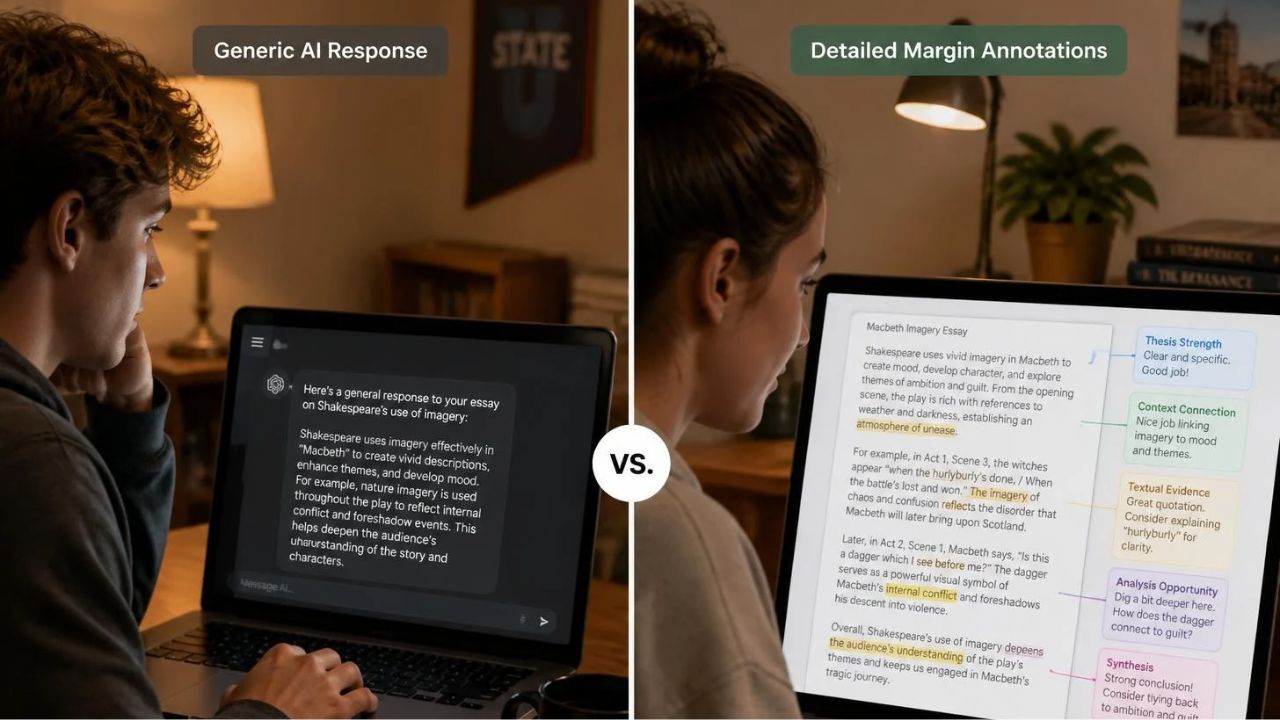
An annotated tutor critique works at a different resolution, showing exactly where the issue occurs, why it needs revision, and how to fix it. Instead of general advice, students receive margin-level guidance tied to specific areas, the kind that Essayo offers.
For example:
AI: “Your argument needs more support.”
Human Tutor: “In paragraph 2, your claim about policy impact is clear, but it lacks supporting evidence. To strengthen your argument, explain how banning single-use plastic throughout the state would benefit the community. For instance, how can the ban minimize environmental pollution? Add one scholarly source to deepen your analysis.”
One is a diagnosis. The other is a concrete, actionable plan. That gap between naming a problem and showing how to solve it is another AI vs Human feedback difference.
AI vs Human Feedback: What’s Actually Happening Under the Hood
To see why this gap exists, it helps to know what a Large Language Model (LLM) is actually doing when it “gives feedback.” A language model doesn’t read your essay. It predicts the next most statistically likely word, one token at a time, based on patterns learned from training data. It has no persistent model of your argument, no memory of your professor’s rubric, and no concept of “correct” beyond what’s statistically common. That’s why its comments default to the most generic, most frequently-seen advice in its training set, “add more evidence,” or “clarify your thesis,” regardless of what your paragraph specifically needs. It sometimes even asks for details that are already there.
AI detectors work from the same statistical logic in reverse. Instead of generating predictable text, they measure it, looking mainly at two properties:
Perplexity: how predictable each word choice is, given the words around it. AI-generated text tends to choose the most probable next word, so it scores low (highly predictable).
Burstiness: how much sentence length and complexity vary across a passage. Human writing naturally swings between short punchy sentences and long, complex ones; AI-generated text tends to stay in a narrower, smoother range.
This is precisely why detectors misfire so often. Formal academic writing, technical vocabulary, and non-native English phrasing can all score as “low-perplexity” and “low-burstiness” for entirely human reasons, triggering false positives. It’s also why simply running flagged text through an “AI humanizer” tool rarely helps. It only resets the statistical signature, without adding the judgment, structure, or argument a human reader is actually grading.
AI Cannot See Academic Integrity Risks
An AI tool has no model of academic norms or the line between revision and dishonesty. It can’t flag when a suggested phrase edges into territory an instructor would consider ghostwriting. That’s how students end up, often without meaning to, adopting AI-generated phrasing wholesale or drifting from the assignment’s actual goals.
A human tutor reviews with academic integrity built in as a constraint, not an afterthought, helping students revise in a way that keeps the ideas, and the ownership, theirs.
AI Is Fast. Tutors Make Students Better.
Speed and learning are different variables. AI can return a comment instantly, but instant feedback tends to produce instant, unreflective revision — the sentence changes; the underlying skill doesn’t.
Human critique forces a pause long enough for the reasoning to land. Students see why a passage needed to change, not just what to swap in — which is the only version of feedback that transfers to the next essay, the next class, the next job.
AI can improve a draft. Only a human tutor help improves the writer producing it.
Where Essayo Fits Into the Writing Workflow
Three problems show up consistently for students drafting with AI:
AI feedback is generic and cycles through the same handful of comments.
AI detectors are inconsistent, and getting flagged is stressful regardless of intent.
3.Professors are explicitly grading for original voice and depth of analysis, the two things AI is worst at producing.
No amount of re-prompting solves any of these; software can only generate or rephrase more text. Essayo exists to close the actual AI vs human feedback gap: it pairs AI-assisted drafting with expert human critique that delivers:
sentence-level annotations,
structural guidance,
concrete revision strategies,
and feedback checked for academic integrity.
Every draft moves through a 24–48 hour annotation queue, so students get depth and speed, not one at the expense of the other. AI for efficiency, humans for expertise: that’s the actual division of labor writing support should run on.
Final Takeaway
AI can polish a draft. Human tutors help transform the person writing it.
Under deadline pressure, AI feedback feels like the safer bet. It isn’t. It produces cleaner sentences, not stronger arguments. When it comes down to AI vs human feedback, human-annotated critique is the higher-leverage move, every time.
That’s exactly what Essayo delivers.