How to Revise an AI-Generated Essay Step by Step
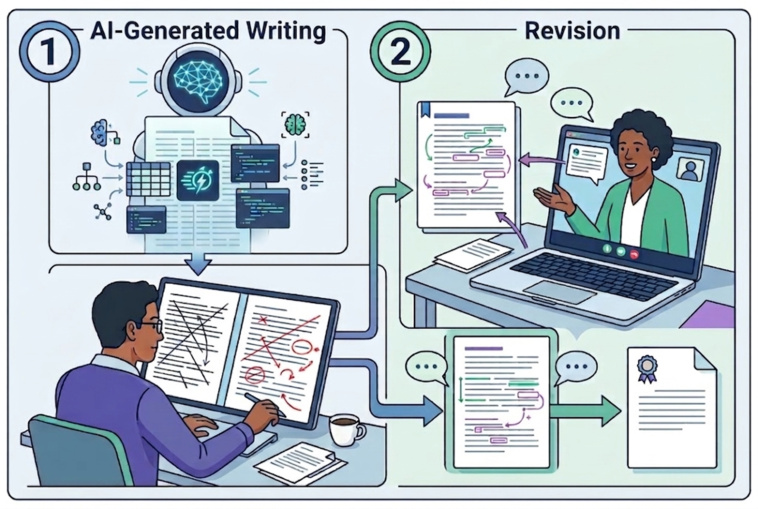
Artificial intelligence can draft an essay in seconds, but a draft is not a finished product. It's a starting point that still needs a thinking, questioning human behind it. Knowing how to revise an AI generated essay is quickly becoming a core academic skill, one that separates students who use AI as a crutch from those who use it as a tool.
This article walks you through a 7-step process for turning a raw AI draft into original, well-supported writing, while also helping you build the skills that revision is meant to teach.
The Revision Process
A generated draft may contain factual errors, generic arguments, or a voice that doesn't sound like you at all. Revising this draft isn't optional polish. Rather, it's where the real learning happens and where you reclaim ownership of the work.
Step 1: Read the Draft Before You Touch It
Before changing a single word, read the entire draft from start to finish. This first pass is about understanding what the AI actually produced, not fixing it yet.
While reading, ask yourself:
Does the essay actually answer my assignment prompt?
Is there a clear thesis, and does the essay stick to it?
Where does the paper feel thin, repetitive, or off-topic?
This first step builds critical reading skills. You're evaluating an argument before you accept it, which is exactly what strong writers do with their own first drafts.
Step 2: Check the Paper’s Structure
Now look at the essay's skeleton: Does each paragraph build logically toward the thesis, or does the AI drift into padding?
This stage is when you should start making changes to the draft:
Cut circular reasoning. AI often restates the same point in new words.
Make sure transitions actually connect ideas, not just paragraphs.
Reorder sections if the logic would flow better differently.
Restructuring is an effective way to revise AI essay content into something that meets your specific writing objectives.
Step 3: Fact-Check Every Claim and Strengthen Evidence
This is one of the most important steps in how to revise an AI generated essay. AI models can make confident-sounding statements that are simply wrong, and unverified claims can undermine your credibility fast.
Never assume a statistic, quote, date, or source is accurate just because it reads smoothly:
Verify names, numbers, and citations against real sources.
Delete any claim you can't confirm and cut any example that feels like filler.
Flag generic examples and vague sourcing like "studies show." Replace them with verifiable details from your own research or experience.
Explain why the evidence supports your own point. Don't just drop a quote, an example, or some numbers and leave readers to interpret them on their own.
Adopting these measures makes you do the intellectual work the AI skipped, reinforcing research and analytical skills.
Step 4: Rewrite in Your Own Voice
AI writing also tends to sound smooth but generic, with predictable sentence rhythms and safe word choices, so the next step is to rewrite in your own voice:
Read each paragraph aloud, then rewrite it the way you'd actually say it in class or to an academic audience.
Swap generic phrases for specific, personal insight or examples.
Vary sentence length. AI drafts often default to a flat, even rhythm.
This fourth step happens to be one of the best exercises for developing your personal writing style since you're actively comparing your instincts against a neutral AI baseline.
Step 5: Consult a Human Tutor
No matter how careful your self-revision is, a second set of human eyes catches things you can't see in your own work. Bring the revised draft to a teacher, a trusted peer reviewer, or an expert tutor over at ESSAYO.
An expert tutor can:
Spot logical gaps or unclear reasoning you've read past too many times to notice.
Push back on ideas or arguments that seem weak, redundant, or irrelevant.
Provide you with specific and actionable revision steps: what to fix and how to fix it.
Confirm whether your voice reads as authentic.
This step matters for a reason beyond quality control: It protects student agency. A tutor consultation keeps a human (not an algorithm) as the final judge of whether your ideas are sound and your writing is honest. It also turns revision into a dialogue, which can help you build confidence and argumentative skills in ways editing alone cannot.
Step 6: Proofread for Mechanics
Once the draft’s structure, content, and voice are solid, do a final pass for grammar, punctuation, and formatting:
Use an automated grammar and spell-checker to help you catch the more obvious mistakes.
Read the essay backward, paragraph by paragraph, to catch other writing errors your brain would otherwise autocorrect.
Check whether the citation, font, spacing, heading, and layout formats all match your assignment's requirements.
This step is all about polishing your work and making it look neat and easy to navigate.
Step 7: Compare the Final Draft to the Original Prompt
Before submitting, reread the assignment prompt one more time and confirm that every requirement is met: topic and argument focus, word count, sources, formatting.
This final check ensures the essay reflects your clear understanding of the assignment, not just an AI response to the prompt.
From Draft to Original Work
Revision transforms an AI draft from a generic starting point into a piece of writing that reflects real thought, real evidence, and a real voice. Each step in this process, from fact-checking to rewriting to consulting an ESSAYO tutor, builds academic skills that matter far beyond this one assignment: critical reading, argument-building, research, and self-editing.
Used this way, AI becomes a launching pad rather than a shortcut, and the student, not the algorithm, stays firmly in control of the final work.