The Ethical Line: How to Use AI for Brainstorming Without Academic Dishonesty
Every student knows that blank-page feeling of staring at a blinking cursor and having absolutely no idea what to write while a deadline looms over their head.
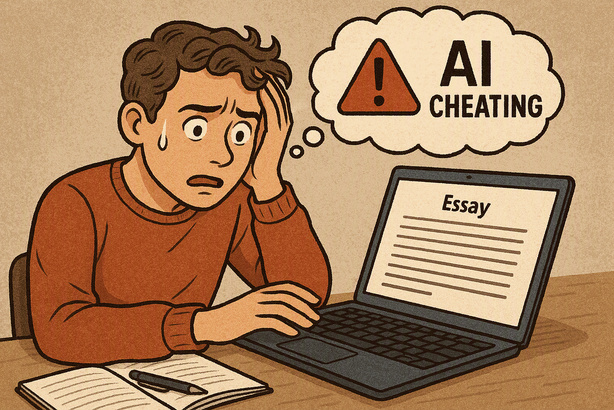
One of the most popular ways to break through this wall is to use AI for brainstorming. But for many students, using AI tools to write is quickly followed by the question: Will my AI essay get flagged for cheating?
The Anxiety Behind the Use of AI for Brainstorming
Many students using AI tools can claim that they didn’t copy their essay or fabricate a source. Instead, they just asked AI to help them think, yet they worry that
a detection tool will treat their process as misconduct
a professor won't distinguish between "AI helped me think" and "AI did my thinking for me,” and
even just asking AI for a second opinion makes them, statistically, seem guilty.
These anxieties are real, and they come from a gap in how schools evaluate students’ written works. Currently, many schools lean on AI-detection software to flag AI use. On paper, this sounds like a clean fix: run the text through a tool, get a percentage, and make a judgment call. But in practice, it's far messier.
Detection tools analyze patterns, not intent. They can't tell the difference between a student who brainstormed with AI and then wrote every word themselves, and a student who submitted AI-generated text wholesale. Both can produce similar linguistic fingerprints, and that causes problems:
False positives flag honest students, sometimes based on nothing more than clean, well-structured prose.
False negatives miss genuine misuse, especially when text is lightly edited afterward.
No context is captured. A detection score can't show how a student used AI, only that AI-like patterns exist somewhere in the writing.
The result is an unreliable system, leaving students guessing what's "safe," while their teachers make high-stakes judgment calls based on incomplete information.
How Human Tutors Are the Missing Piece
Human tutors at ESSAYO can play a role that AI-detection tools and even AI writing assistants can’t. They give detailed, written feedback to students, showing them exactly how to fix and strengthen their work.
When a section gets flagged as being AI-generated, tutors don’t simply ask "is this written by AI?" Rather, they ask "does this actually sound like the student wrote it, and do they understand what it says?" This process helps distinguish comprehension from pattern-matching, so students who brainstormed with AI but did the thinking themselves can usually revise after receiving feedback. Those who outsourced the whole material often can't.
AI also tends to generate plausible points rather than rigorously tested ones. Human tutors can pressure-test logic by asking questions like "what's the strongest objection to this claim?" or “how will your target audience find this argument relevant?” This encourages students to develop stronger, more defensible ideas.
While AI-assisted brainstorming is good for generating structure and phrasing, human tutors are better equipped to determine whether a claim is actually supported by the student’s sources. Human tutors can also model revision. Instead of rewriting a weak or robotic-sounding paragraph, a tutor strategically uses personalized instructions, guide questions, and parallel examples to show the student how to improve it, which is a transferable skill instead of just a one-time fix.
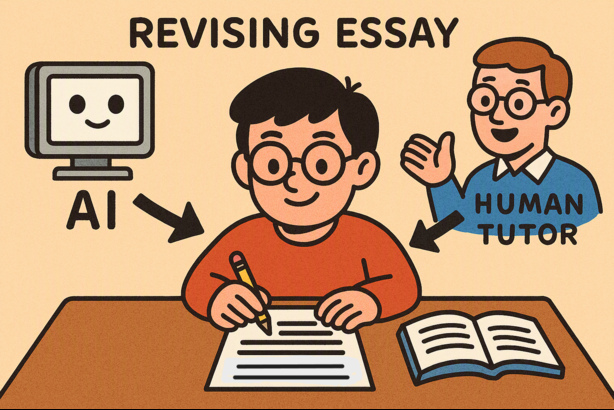
Thus, rather than flag patterns, tutors aim to understand a student's thinking and help them own it, and here’s how that can play out in practice:
Students use AI for brainstorming. AI can help them generate ideas, get unstuck, and even explore new angles so that they can begin drafting their work.
Students consult human tutors to help test whether ideas they use actually hold up. Tutors also verify comprehension, clarity, and originality.
Students, now informed by both AI and human tutors, revise their work to strengthen their reasoning and ensure their authentic voice shines through.
AI is excellent at breaking the blank-page problem, while tutors are excellent at everything AI can't verify: genuine understanding, whether an argument survives scrutiny, and whether the final draft actually sounds like the student. This combination helps ensure students don’t cross the ethical line into academic dishonesty.
Moving Forward Together
The use of AI for brainstorming isn't going away, and it shouldn't have to. Used well, it's simply a new way for students to think out loud, explore possibilities, and get past the hardest part of any assignment: getting started.
ESSAYO doesn’t seek to police AI use after the fact. Instead, it aims to build a human-supported process around it so that honest use of AI and academic integrity aren't treated as being in tension with each other.
This is not just a better process for educational institutions. It's also a kinder process for students who are trying to do the right thing in an AI-driven landscape that's still figuring out its own rules.