Why Proofreading Isn’t Enough: Structural Revision vs Simple Grammar Checks
Proofreading may be the final step in the writing process, but it only catches surface errors. It doesn't fix underlying structural issues and faulty reasoning. It also doesn’t effectively address common AI markers in student essays.
Now that AI tools make surface-level polishing easier than ever, the distinction between proofreading and revision matters more than many writers realize.
What Proofreading Actually Does
Proofreading is a check for correctness, not overall quality. It typically catches the following:
Spelling, grammar, and punctuation errors
Formatting inconsistencies
Repeated or missing words
These writing issues are definitely worth fixing. An error-free paper is easier to read and will appear polished and professional to its target audience.
Grammar and spell-check programs are also widely accessible. They’re fast, consistent, and good at catching the small errors tired human eyes can easily miss.
The process of proofreading can be as simple as running a draft through a checker, reviewing flagged items, and accepting recommended changes.
Why Structural Revision Is Important
But a perfectly spelled paper can still contain a weak argument, an unclear point, or no real insight at all. That’s why proofreading isn’t enough and why structural revision matters.
Structural revision ensures that bigger, harder questions about the draft’s quality are addressed:
Does this paragraph belong here, or does it interrupt the flow?
Is the thesis actually supported by the evidence that follows it?
Does each section build on the last, or is some important context mixing?
Is there a real argument here, or just a series of true statements?
Revision means re-examining the essay's structure and determining whether its key ideas are logically organized, clearly relevant, and sufficiently supported. This is a more complex and challenging process than proofreading.
Revising a paper may require:
multiple intensive readings of the draft to check for argument flow,
reading the text out loud to expose unclear or incomplete explanations,
reverse-outlining the essay to more easily spot what paragraphs may be redundant or missing clear connections to the thesis, and
stepping away from the paper for a few hours, or even overnight, so that it can be revisited with fresher eyes.
All these can make revision feel like a strenuous and time-consuming task for many students. Automated proofreading tools also aren’t equipped to effectively help with meaningful revision.
Spell-checkers can’t verify arguments. They can't judge relevance. They can't ask "so what?" or “why does this point matter?”
This isn't a flaw in the tools. It's simply outside of what they were built to do.
Where Human Tutors Make the Real Difference
Structural revision requires judgment, not just pattern recognition, and human tutors at ESSAYO are well-equipped to help students detect faulty and weak reasoning, idea repetition, and off-topic discussions.
Tutors bring fresh, objective eyes to the essay. They can provide expert guidance on structure, argumentation, and clarity, unlike automated grammar and spell-check programs.
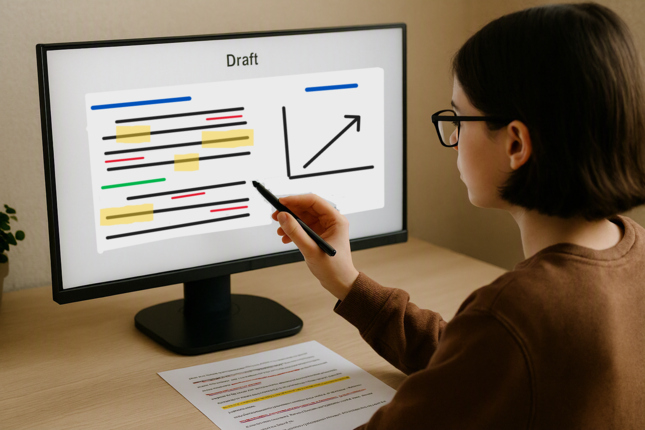
Tutors also don't just mark what's wrong; they explain why it matters and show students how to fix it. Actionable, written feedback looks very different from a red underline. It might sound like:
"This paragraph restates your thesis instead of advancing it. Try connecting it to your second point instead."
"Your strongest evidence is buried in paragraph four. Consider moving it earlier."
“Your second paragraph reads more like a summary of the novel rather than your own analysis. You need to explore what the author is arguing through their characters.”
Such feedback demands real structural revisions, encouraging students to develop more meaningful paragraphs.
The tutoring process also teaches revision as a skill: A student who understands why a line of reasoning didn't work or wasn’t strong enough can apply that lesson to the next essay, not just the one.
The Bigger Picture
Proofreading and structural revision aren't competing tasks. Rather, they're both critical steps in the writing process. Proofreading polishes what's already there. Structural revision decides what should be there and in what order the information may be best presented.
Although automated checkers make the proofreading process fast and simple, they are ineffective at providing meaningful revision advice. That’s a gap human tutors can effectively fill.
Students don’t have to revise on their own. Human tutors like those at ESSAYO can help, not by recommending surface changes and simply replacing students’ ideas, but by asking the questions that guide those students into making their writing on the page clearer, sharper, and deeper.